
The call that makes people doubt themselves
Every spring we get the same phone call. The caller says it rained for three days, the basement was dry on day one and day two, and on the morning of day three there was an inch of water along the back wall. Then comes the question. They ask whether something broke, whether the plumbing is leaking or whether the house is sinking.
Usually nothing broke. The house is doing what a house does when it sits in clay. The water that arrived on day three started falling on day one. It just took that long to get there, and the delay is the part that confuses people into thinking the problem is new.
What clay actually does with rain
Most of the ground around Peachtree Corners and the rest of Gwinnett is Piedmont red clay. Clay is made of very fine particles, and water moves through it slowly. Sand lets rain pass through in minutes. Clay can take hours to take in a small amount, and then it holds on to it.
In a normal week that does not matter. The soil near the foundation takes in the rain it can and sheds the rest across the surface. After two or three days of steady rain, though, the soil beside the house is full. A saturated clay yard behaves like pavement. The next inch of rain has nowhere to go, so it runs along the surface toward the lowest point, and many of those low points are basement walls.
Why it pushes instead of just sitting there
Water in soil has weight. A column of wet clay beside a basement wall is pressing sideways on that wall, and the deeper the wall, the stronger the push. Builders call it hydrostatic pressure. It is the same force that makes a deep swimming pool press on the walls of its hole.
A foundation that is tight in a dry week can have hairline cracks, a gap where the wall meets the floor, or a mortar joint that has not been looked at in thirty years. Those are all small openings, and they are enough. The water finds the cove joint first, because it is the lowest seam in the room. You see a damp line along the baseboard, then a puddle, then wet carpet.
Rolling lots make it worse
Peachtree Corners is not flat. Lots roll, streets climb and rain that falls on a hilltop yard keeps going downhill. The house at the bottom of that slope gets its own rain plus part of the rain from everything uphill. If you live on a low lot, or on the downhill side of a sloped one, the clay near your walls fills faster than your neighbor's.
Add a few things we see all the time. Gutters that empty beside the foundation. Downspout extensions that were knocked off by a mower. Mulch beds that are piled against the siding and slope toward the house. Window wells without covers. Each one adds a bucket or two to a yard that is already full, and the basement is where the bucket ends up.
What we do when the call comes in
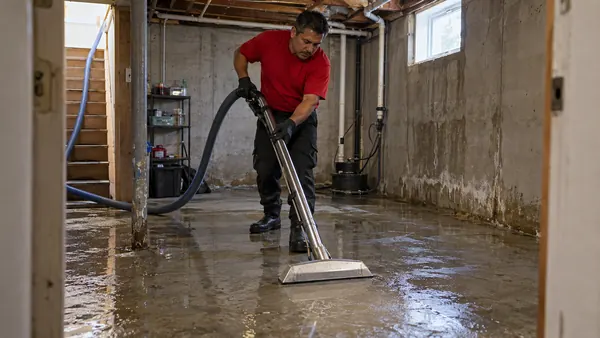
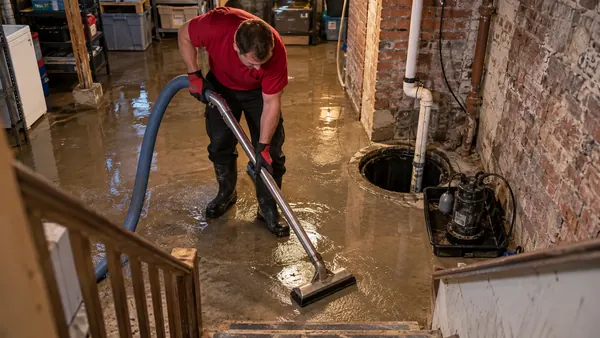
The first step is to get the water out. We use weighted wand tools and portable pumps on the slab, and we pump the sump pit if there is one. Then we pull what is holding water against the wall, such as carpet, pad, stored cardboard and the bottom of any finished drywall. Those materials feed mold and prolong the dampness.
Next is the drying. Concrete is slow, and a basement slab can take most of a week with dehumidifiers running. We read the wall, the slab and the framing every day and we leave the equipment in until the numbers match dry material. If the water has been coming in from outside, we use a moisture meter and a thermal camera to find the entry point. That goes into a report.
What we do not do, and who does
We do not fix the reason the water comes in. We dry what got wet, and we tell you where the water entered. The fix is usually a drainage project. An interior French drain with a sump pit, an exterior drain, regraded soil, longer downspout extensions or a sealed window well. A waterproofing or drainage contractor handles those. We will hand them our readings and photos so they are not starting from zero.
We have learned to be careful about one kind of advice. A basement that leaks only after a long rain needs drainage, and a coating on the wall will not hold back a column of water. Be skeptical of any fix that only touches the inside surface of a wall. It can look good for a season and then blister.
What you can do this week
Walk the outside of your house before the next rain. Check that each downspout ends several feet away from the foundation and points away from the house. Look for soil that slopes toward the walls, and for gutters that overflow because they are packed with leaves. Check window wells for debris. If you have a sump pump, pour a bucket of water into the pit and make sure it kicks on and discharges away from the house.
Inside, watch the cove joint after a rainy stretch. A white, chalky crust on block or concrete, called efflorescence, means water has been moving through the wall and leaving minerals behind. It is not just dust. If you see it, take a photo and write the date. That record will help whoever looks at the drainage.
Quick answers
Why does my basement leak only after several days of rain?
Clay takes days to fill. Once the soil beside the foundation is saturated, water pressure builds on the wall and pushes through any opening. A short storm often cannot do that.
Is a damp basement wall always a groundwater problem?
Not always. Condensation, a plumbing leak or a dryer vent can also wet a wall. A moisture meter and a look at the weather record tell the difference.
How long does it take to dry a basement after a clay-seep flood?
Standing water is out in a few hours. The slab, the wall base and any framing usually take four to seven days with dehumidifiers running.
Can you stop it from happening again?
We dry the structure and document the entry. A drainage contractor installs the fix. Both are needed to keep the basement dry.