Why clay holds water against foundations
Most of the ground under this part of Gwinnett is Piedmont red clay. Clay takes water in slowly and gives it up even slower. After a few days of rain the soil around a foundation is full, and every new inch of rain has nowhere to go but sideways and down.
That standing water in the soil pushes on the basement wall. Engineers call it hydrostatic pressure, and a block or poured wall that is tight in a dry week will weep at the cove joint and the cracks when the pressure builds. Rolling lots make it worse, because rain from the higher yards uphill runs onto your lot and soaks in beside the house.
How hydrostatic water shows up inside
This is not a plumbing leak, so the clues look different. Check the lowest level after two or three days of steady rain.
- Water or dampness along the joint where the wall meets the floor
- White, chalky mineral crust on concrete or block walls
- A basement that is dry in July and wet after a stalled spring front
- Wet spots rising from hairline cracks in the slab
- Carpet or storage boxes that feel damp on the floor edge only
- A musty smell that comes and goes with the weather
Telling groundwater seepage from a plumbing leak
The two look alike at first, and the fix is different. A plumbing leak usually has a path: a stain below a bathroom, a wet wall near a water heater or a meter that moves with everything off. Groundwater follows the weather. It shows up after days of rain, along the lowest wall, and fades when the soil dries.
A moisture meter and a thermal camera usually settle it. If the readings are highest at the cove joint and along the downhill wall, and the water bill has not changed, the water is coming from outside.
- Wet only after several rainy days
- Strongest along the cove joint or the downhill wall
- White mineral crust on concrete or block
- No change in the water meter
Why a pump alone does not fix it
A wet vac and a pump clear the floor. They do not touch the water still in the wall, the slab or the soil outside, and that water keeps arriving for as long as the clay stays saturated. On a three-day rain, we often pump the same basement two or three times before the ground lets go.
So the work has two parts. We extract what is standing and dry what soaked in, and we tell you plainly which drainage fix belongs to a waterproofing contractor, such as an interior French drain, a better sump pit or gutter and grading work. Our job is the water already inside. We do not sell you a system you did not ask for.
How a clay-seep basement job goes
Locate the entry
We walk the walls and cove joint with a moisture meter to see where the water is coming through, not just where it ended up.
Extract standing water
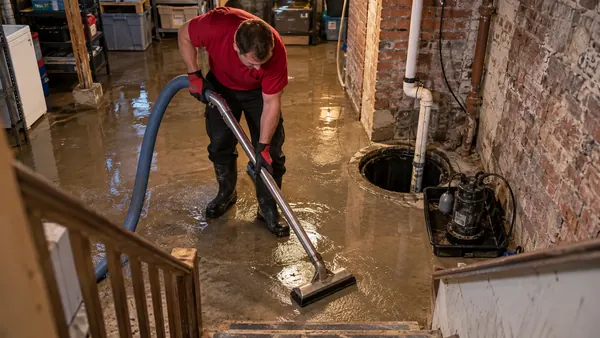
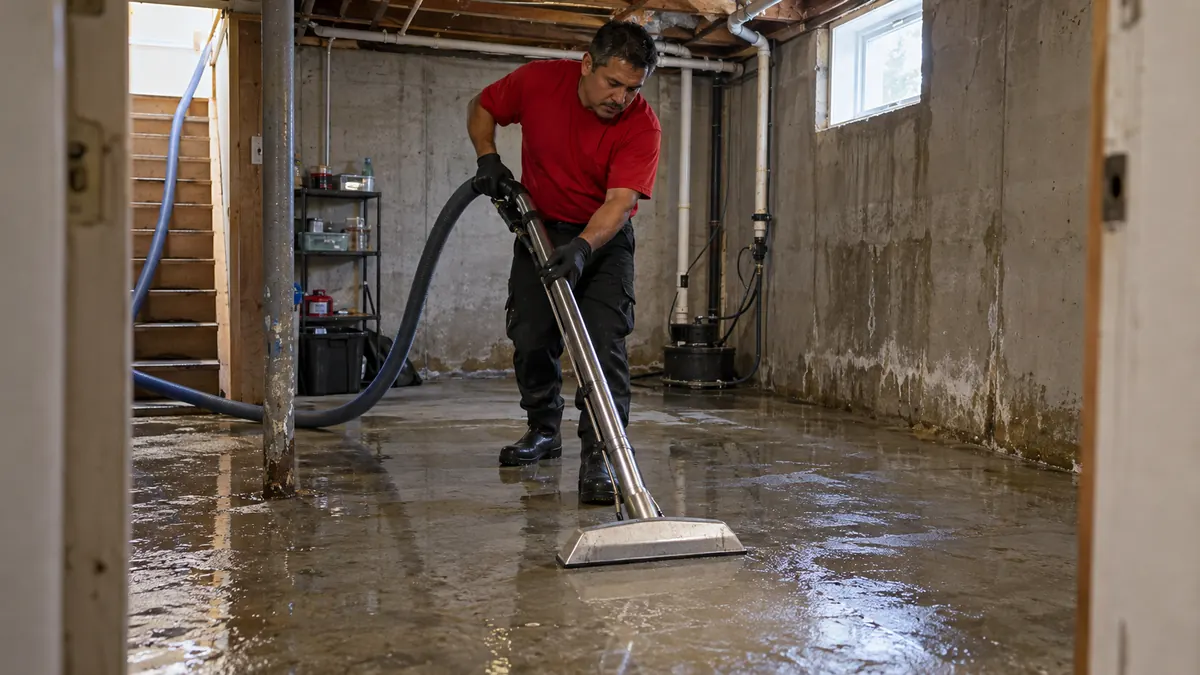
Weighted wand tools and portable pumps clear the slab. Water in sump pits and floor drains is pumped out as well.
Remove wet finishes
Carpet, pad, stored cardboard and the bottom of any wet drywall come out. These hold water against the wall and feed mold.
Open the wall base
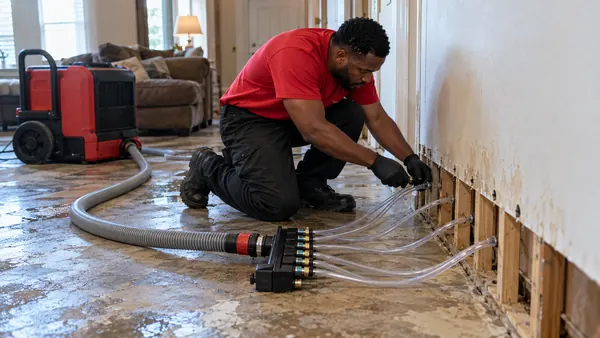
Where finished walls sit on a wet slab, we cut a small flood line and pull wet insulation so the framing can dry.
Dry the structure
Low-grain dehumidifiers and air movers run for several days. Concrete dries slowly, so readings drive how long they stay.
Check and hand off
We log readings on the wall, slab and framing, photograph the entry points and write up what a drainage contractor needs to see.
What we find in clay-seep basements
- Cove-joint seepage that has soaked the bottom plate of a finished wall
- Efflorescence mistaken for harmless dust while water keeps coming in
- A sump pit that is too shallow to keep up with a three-day rain
- Downspouts dumping beside the foundation on the uphill side
Equipment that matters in a clay-seep basement
Weighted wand extractors pull water off the slab, and portable submersible pumps clear sump pits and low spots. Low-grain dehumidifiers matter most afterward, because a basement slab releases moisture for days and fans alone only move damp air around.
We also use moisture meters on concrete and block, and a thermal camera to follow dampness up a wall. The readings tell us when the slab and the wall base have settled to a dry level, not just a dry look.
Before the crew arrives
- Stay out of a flooded basement if water is near the panel or outlets
- Turn off power to the lower level at the breaker if you can reach it dry
- Carry stored items up and off the floor, boxes first
- Move downspout extensions away from the foundation, if it is safe to go outside
- Photograph the wet wall and floor, and note the rain dates
- Do not run a household vacuum on the water
Hydrostatic extraction cost
These are typical estimates for the metro Atlanta area, not guaranteed prices. A single wet basement room with no finishes sits at the low end. Finished basements, repeat pumping during long rain and slab drying push toward the top. Drainage and waterproofing work are separate trades. Call for an exact quote.
| Job type | Typical estimate |
|---|---|
| Single-room seepage, bare slab | $600 – $1,800 |
| Whole unfinished basement, one pump-out | $1,200 – $3,000 |
| Finished basement with wall and carpet removal | $3,000 – $8,500 |
| Repeat extraction during a multi-day rain | $400 – $900 per visit |
| Slab and wall drying, equipment days | $900 – $3,000 |
Questions we hear about this
Is this water damage from rain or from a leak?
Groundwater is not a plumbing leak, but the damage is the same. Whether your policy pays depends on the wording, so read it and call your agent before assuming.
Will the water come back?
It can, every time the clay saturates, until drainage is fixed. We dry what got wet and write down where it entered so the right trade can solve it.
How long until the basement is dry?
Standing water is out in a few hours. Concrete and framing usually take four to seven days with equipment running.
Do I need to tear out the carpet?
Carpet that sat in groundwater is usually removed, because the pad holds contaminants and keeps the wall base wet. Dry carpet beyond the wet edge can sometimes stay.
Can you fix the cracks?
We do not seal foundations. We dry the structure and point out the entry. A waterproofing contractor handles injection, drains and grading.
Do you work in Duluth and Norcross too?
Yes. The same clay sits under most of Gwinnett, and we run this job in Norcross, Duluth, Dunwoody and the neighborhoods around them.
Where we see this most
- Norcross, GACecil clay pooling against block stem walls and older brick foundations near Jones Bridge Road.
- Dunwoody, GATree roots crowding old footing drains, so water backs up at the cove joint.
- Tucker, GASplit-foyer homes with finished lower levels that take the wall pressure.
Read next Why Georgia red clay turns a rainy week into a wet basement.