
Mold work we do in Peachtree Corners
Pick the one that sounds like your problem. If you are not sure what you are looking at, call and describe it.
Mold after water damage
Containment, removal of infested drywall and framing cleanup after a leak or burst pipe left walls damp.
View service →Crawl space mold
Mold on joists and subfloor from damp clay soil and humid vented air is cleaned and the wood is dried.
View service →Mold behind finished basement walls
Seepage that wetted drywall and carpet in a lower level grows mold in the dark. We remove it and dry the block.
View service →Attic and ceiling mold
Pipe leaks, roof leaks and clogged HVAC drains wet attic insulation. We open it up, remove it and dry the framing.
View service →Bathroom and closet mold
Weak exhaust fans, leaking vanities and exterior closet walls hold dampness. We remove growth and show you the cause.
Mold after a flood or storm
Storm water that soaked drywall and flooring needs cleaning, treatment and drying before spores take hold.
View service →Hidden mold behind walls
A musty smell with no visible source usually means a wet cavity. A thermal scan finds it first.
View service →Moisture control after removal
Dehumidifiers and air movers bring the space to a stable moisture level so growth has nothing to feed on.
View service →Problems we solve
A musty smell you cannot trace
We find the damp spot behind the wall, under the floor or above the ceiling, then deal with what is growing there.
Black or green patches on drywall
Visible growth on walls and ceilings is cut out, bagged and removed under containment.
Mold that came back after cleaning
Scrubbing the surface does not fix a wet cavity. We open it, dry it and remove what is feeding it.
Wet insulation and framing
Soaked insulation holds water for weeks. It comes out so the wood behind it can dry.
Cupped floors and sticking doors
Humidity from the crawl space reaches the floor above. We look underneath, not just at the boards.
Mold found during a home sale
An inspector flags growth in a crawl space or attic. We scope it, remove it and document it.
Why mold is such a regular visitor here
Humid summers
Warm, wet air condenses on cool ducts, windows and the back of exterior walls without any leak.
Red clay soil
Clay drains slowly and releases moisture into crawl spaces and basement walls for days after rain.
Vented crawl spaces
Open vents bring in the same humid air that wets the joists. The wood stays damp all summer.
Aging homes
Roofs, flashings, water heaters and supply lines from the 1970s to the 1990s are all nearing the end of their lives.
Creek and river lots
Lower lots near the Chattahoochee side of the city take storm runoff, and the wet ground keeps lower levels damp.
Where mold hides in a Peachtree Corners house
Crawl space joists and subfloor
Vented crawl spaces over damp clay stay wet for months. Growth shows on the joists above the ducts first.
The base of basement walls
Seepage at the cove joint wets paneling, carpet and the bottom of drywall. Mold grows on the back of the paper.
Attic roof deck and insulation
Pipe, roof and condensate leaks soak insulation. In a hot attic, growth spreads along the underside of the decking.
Behind bath and kitchen walls
A slow supply or drain leak wets the cavity for years. The first sign is often a soft baseboard or a stain.
Closets on exterior walls
Little airflow and a cold wall make a closet a damp pocket. Shoes and boxes on the floor hide it.
HVAC closets and duct runs
Condensate lines clog and cold ducts sweat in humid weather. The surrounding drywall and insulation stay wet.
What remediation is, and what it is not
Mold remediation is the work of finding the moisture, removing the growth and the materials it has soaked into, cleaning what stays and drying the structure so it does not come back. It is not a promise of a sterile house. Mold spores are in the air of every home, and no one can remove all of them.
It is also not a coating. Spraying a product over visible growth, or painting over a stain, hides the problem and leaves the water in place. A cleaned wall that is still damp will grow mold again, which is why the moisture work comes first.
We separate three jobs that often get mixed together. Remediation is our work. Testing, if you want it, belongs to an independent tester. Rebuilding, such as drywall, paint and flooring, belongs to a contractor. Keeping them apart keeps the incentives honest.
Where our mold calls come from
In Gwinnett cities such as Norcross, Duluth, Lilburn and Suwanee, most calls come from vented crawl spaces and finished basements on clay. The air is humid, the soil holds water and the first sign is a smell in the living room.
In north DeKalb, including Doraville, Chamblee, Tucker and North Decatur, the calls are often older crawl spaces, split foyers with finished lower levels and historic homes with chronic dampness.
In North Fulton and nearby, such as Alpharetta, Roswell, Sandy Springs and Dunwoody, we see more finished walk-out basements, hidden cavities behind custom work and condensate leaks from large HVAC systems.
What a containment day looks like
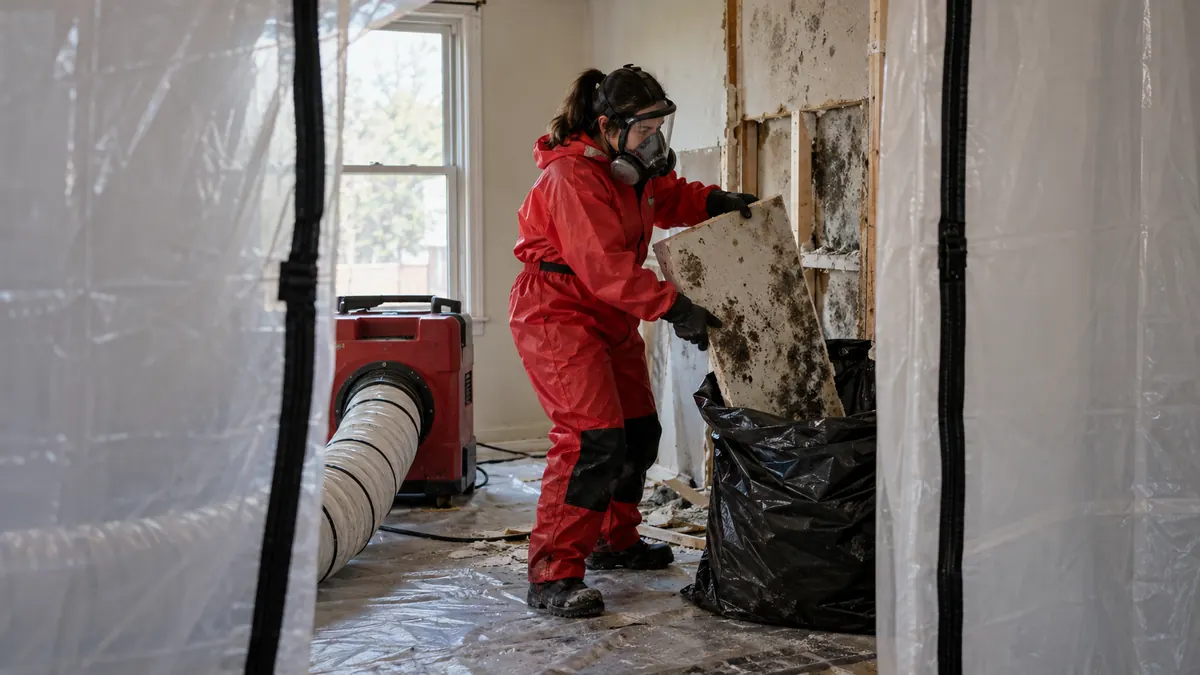
On the morning of the work, the crew seals the area with plastic sheeting, sets a negative air machine with a HEPA filter and tapes the edges so air flows into the work zone, not out of it. Crew members wear respirators, suits, gloves and boots.
Affected drywall and insulation are cut out in sections and bagged inside the containment. The studs and plates are HEPA-vacuumed and cleaned. Surfaces are treated, and dehumidifiers go in to dry the cavity. Before the plastic comes down, we confirm the area is clean and the readings are heading in the right direction.
How a mold job goes
Find the moisture
A moisture meter and thermal camera show where the damp is. Without the source, the rest does not last.
Contain
Plastic sheeting and negative air keep spores from drifting into clean rooms.
Filter the air
HEPA air scrubbers run through the work and capture airborne particles.
Remove
Drywall, insulation and porous materials with growth are cut out and bagged. Framing is HEPA vacuumed and cleaned.
Dry
Dehumidifiers dry the cavity until readings are steady and match dry material.
Document
We give you a written record of what was removed and how dry the structure is. Rebuilding is a separate trade.
Mold removal cost in Peachtree Corners, GA
| Mold job | Typical estimate |
|---|---|
| Small area, one room, drywall only | $800 – $2,500 |
| One or two rooms with containment | $1,500 – $8,000 |
| Basement with finished walls | $3,000 – $10,000 |
| Crawl space mold and framing cleaning | $2,000 – $7,500 |
| Attic with insulation removal | $2,000 – $7,000 |
| Whole-house or multi-area | $8,000 – $30,000+ |
These are typical estimates for the metro Atlanta area, not guaranteed prices. Call for an exact quote. Rebuilding, plumbing and drainage repairs are separate.
What moves the price of a mold job
Four things set most of the price. The first is the area, because more material means more containment and more disposal. The second is the depth of the damage: surface growth on a dry wall is far less work than growth through insulation and subfloor. The third is access, since a tight crawl space or a high attic takes more time. The fourth is the source. If the water is still active, drying and repair come first.
- Area and how many rooms are involved
- How deep the growth is
- Access: crawl space height, attic or finished walls
- Whether the moisture source is fixed
- Containment and air filtration needed
Mold and insurance in Georgia
Many standard policies cover mold that follows a covered water loss, such as a sudden pipe failure, and exclude mold that comes from long-term seepage or neglected maintenance. Some policies cap mold coverage at a set amount. Your policy and your agent decide what applies.
What helps in every case is documentation. Photos of the growth, a moisture map, readings that show when the area was wet and a written scope of what was removed all make the claim clearer. We provide those with every job.
Keeping mold from coming back
- Fix leaks as soon as you see a stain or a drip
- Run bath fans to the outside and let them run after showers
- Keep indoor humidity below about 55 percent in summer
- Clear gutters and extend downspouts away from the foundation
- Keep crawl space vents clear and the vapor barrier intact
- Do not store cardboard on a basement floor
- Check closets on exterior walls once a season
Questions people ask about mold
Is all mold toxic?
Mold is a normal part of the outdoors, and it can cause problems indoors. Color does not tell you how serious it is, so we treat all growth with the same care.
Should I clean mold with bleach?
No. Bleach does not fix a wet wall and can leave water behind in porous material. Removal and drying work better.
How long does mold take to grow?
In Georgia humidity, it can begin on wet drywall and wood within a day or two, and it grows fast when the materials stay wet.
Will you test for mold?
We can work with an independent tester if you want one. Our job is to remove growth and the moisture that feeds it.
Does insurance pay for mold?
Many policies cover mold that follows a covered water loss and exclude mold from long-term seepage. Ask your agent.
Can I stay in the house?
Usually yes for a contained room. For larger work or anyone with breathing trouble, staying elsewhere can be wise. We will tell you what we see.
See or smell mold?
Call before it spreads. We will tell you if it needs containment. (470) 291-8279.